Superweapons
The four late-game programs — Long Nine, Blackout, Aegis, and Kessler — with charge times, costs, strike rings, and the shared rules that keep them fair.
REFERENCE GENERATED FROM LIVE GAME DATA — BALANCE v156 · 2026-10-14 · NUMBERS UPDATE WITH EVERY RELEASE
Four late-game programs, each answering a different question. They can be disabled per match in the setup screen. A shared shock rule keeps them honest: a single building can lose at most 65% of its maximum HP to superweapon damage within any 75s window — synchronized volleys cannot one-shot what matters.
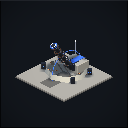 Long Nine
The offense. A Moon-only coilgun that hurls an inert kinetic slug at any explored cell on any world. No warhead, no interception by armor — just mass, gravity, and a ground telegraph your enemy gets to read.
- Cost: 2400c + 250m + 200r · 4×4 footprint · 1800 HP · 40 power
- Build time: 20s · requires Coilgun Scaling
- Charge: 300s between uses (recharges at half rate under power shortage)
- Ammunition: 250 He-3 per shot, drawn from the firing theater
- Limit: one per player, anywhere — under-construction counts
| Ring | Radius | Buildings | Units |
|---|---|---|---|
| 1 | 6 su | 65% of max HP | 100% of max HP |
| 2 | 10 su | 35% of max HP | 60% of max HP |
| 3 | 14 su | 15% of max HP | 30% of max HP |
Strike damage is percent-of-maximum-HP by ring, friendly fire included, ground layer only. The impact point telegraphs on the ground for 10s before it lands.
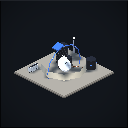 Aegis Umbrella
The defense. An interception umbrella — any superweapon strike whose impact point falls inside its radius is destroyed in flight, automatically, for a per-interception fee. If you can't pay, the umbrella sits unarmed.
- Cost: 2000c + 150m · 3×3 footprint · 1400 HP · 25 power
- Build time: 15s · requires Aegis Protocol
- Charge: 420s between uses (recharges at half rate under power shortage)
- Umbrella: 26 su radius · each interception auto-bills 300c + 50m (unaffordable = unarmed)
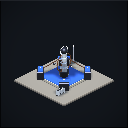 Blackout Charge
The support weapon. A same-theater EMP charge that does zero damage: buildings go dark, defenses reboot first in a staggered wave, and vehicles are stunned in place. The opening move of an assault, not the finisher.
- Cost: 1600c + 120m · 3×3 footprint · 1200 HP · 20 power
- Build time: 15s · requires EW Doctrine
- Charge: 150s between uses (recharges at half rate under power shortage)
- Limit: one per player, anywhere — under-construction counts
- EMP: 12 su radius · 8s inbound telegraph · buildings dark 25s (defenses reboot first, 12s–15s) · vehicles stunned 12s · re-EMP grace 50s
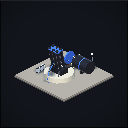 Kessler Barrage
Logistics denial. Sweeps YOUR OWN orbit with debris: enemy shipments parked over the swept world are destroyed, and everything inbound arrives late. You're not attacking their base — you're closing your sky.
- Cost: 2200c + 200m · 3×3 footprint · 1500 HP · 30 power
- Build time: 15s · requires Orbital Interdiction
- Charge: 210s between uses (recharges at half rate under power shortage)
- Limit: one per player per body
- Sweep: parked enemy shipments over the swept theater are destroyed; inbound shipments arrive 45s late. Ordnance never parks — strikes are delayed, never annihilated.